Why a New Metal Roof Might Still Leak Around Gables
A newer metal roof that leaks is almost always an installation problem. Learn how gable and flashing mistakes cause leaks and how a roof inspection finds real fixes.
“My New Metal Roof Is Leaking!” – A Story We Hear More Than You’d Think
We recently got a call from a landlord — let’s call her Lisa — who owns several rental homes. One of her properties had a metal roof that was only a few years old, but water was already showing up inside on the first floor.
Lisa told us the roof “just doesn’t look like it should” and suspected the leak was coming from the back of the house where there’s a gable. She wasn’t sure, but she had a feeling something around that detail hadn’t been done right. And she was exactly on the right track.
When a relatively new metal roof leaks, it’s almost never because the panels themselves have suddenly failed. It’s usually installation mistakes around details like gables, flashing, and penetrations. That’s where a thorough roof inspection really earns its keep.
Why Newer Metal Roofs Leak Around Gables
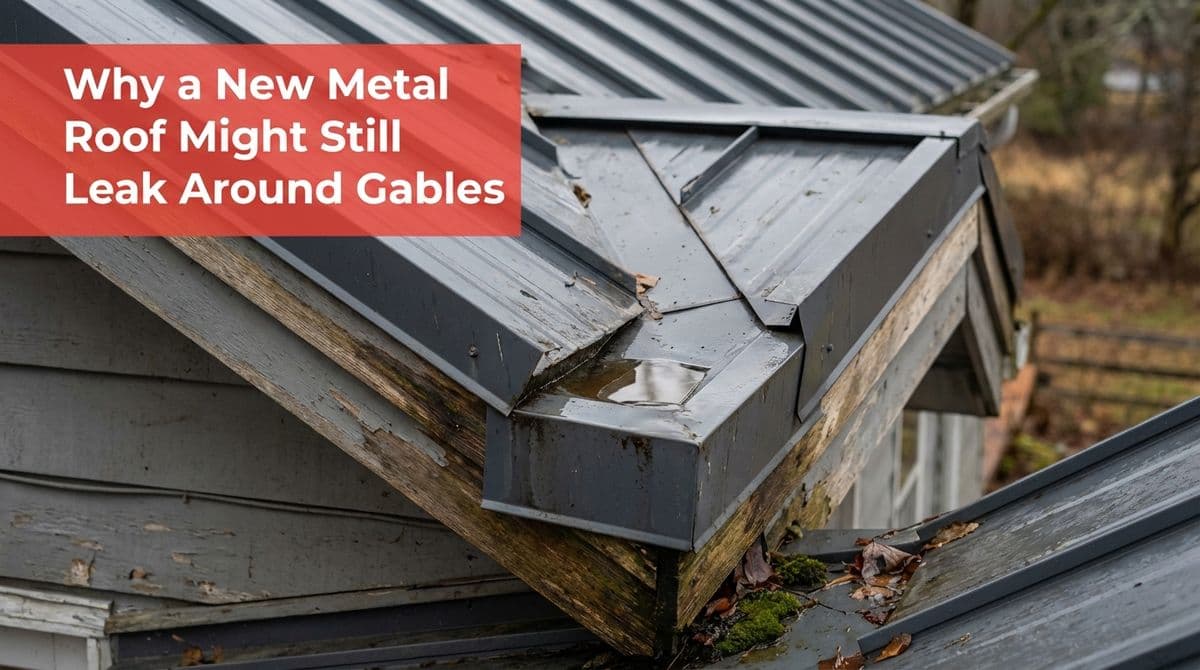
The gable area (the triangular end wall of the house where the roof meets the vertical siding) is a common trouble spot, especially on metal roofs. You’ve got different materials coming together, changes in slope, and sometimes valleys or transitions — all places water loves to find the tiniest opening.
When we see a leak like Lisa described — coming in on the backside of the house and staining ceilings or walls below — we immediately start thinking about these common gable-related issues:
- Improperly installed gable trim that doesn’t overlap panels correctly
- Missing or short underlayment that doesn’t extend far enough up or under flashings
- Gaps at the gable ends where wind-driven rain can be blown under the metal
- Incorrect fastener placement allowing water to follow screws back into the structure
A roof can look “fine” from the ground, but a few missing inches of overlap or a small gap in sealant along a gable can be all it takes to create a leak inside.
Flashing: The Silent Hero (or Villain) of Your Metal Roof
As Lisa suspected, many leaks on newer metal roofs trace back to flashing that “may not have been flashed correctly.” Flashing is the metal (or sometimes flexible) material used to seal joints and transitions: where roof meets wall, where a gable meets the main roof plane, around chimneys, vents, and dormers.
On metal roofs, flashing has to do a lot of work. Common mistakes we find include:
- Wall flashing not tucked behind siding – If flashing is surface-mounted on siding instead of properly integrated behind it, water can run behind the flashing and into the wall.
- Insufficient overlaps – Flashing pieces should overlap by several inches in the direction of water flow. Short overlaps let wind-driven rain push right through.
- No closure strips at transitions – Without foam or metal closures, ribbed metal panels leave gaps that invite water, insects, and even small critters.
- Over-reliance on caulk – Caulk and sealants should back up good metal work, not replace it. When caulk alone is doing the sealing, leaks tend to show up within a few seasons.
Because flashing is partially hidden and detailed work, it’s not something most homeowners notice. But it’s one of the first things we look at during a leak inspection.
How a Professional Roof Inspection Tracks Down the Real Problem
When Lisa asked if we could “take a look and tell me what’s going on and what it would take to fix,” what she really needed was a targeted inspection, not just a quick glance. Here’s how we typically approach a situation like hers:
1. Start Inside: Follow the Water Stains
We begin indoors, looking at where the leak is showing up: ceiling stains, wall streaks, bubbling paint. Water doesn’t always drip straight down — it can run along rafters or framing before showing itself. We map the visible damage, then translate that to an approximate area on the roof.
2. Exterior Walk-Around: Check Walls, Gutters, and Gables
Next, we walk the property and pay special attention to the area the owner points out. Around gables and wall-to-roof intersections, we look for:
- Loose or lifted trim
- Rusting or missing fasteners
- Improperly cut panels or exposed edges
- Signs of water staining on siding or fascia
3. On-the-Roof Inspection: Details, Details, Details
Once we’re safely on the roof, we’ll carefully inspect:
- Gable trim and end laps – Are panels correctly hemmed and locked into the trim? Are there gaps the wind can drive rain into?
- Flashing seams – Are overlaps facing the right direction? Are they securely fastened and sealed?
- Fastener patterns – Are screws placed where the manufacturer specifies, or randomly in panel flats?
- Underlayment exposure – If possible, we’ll gently check any exposed edges to see what’s beneath the panels.
We’re not just looking for “where it’s wet.” We’re looking for where the installer deviated from best practices or manufacturer instructions.
Can a Leaky New Metal Roof Be Fixed Without Full Replacement?
In many cases, yes. For roofs like Lisa’s that are only a few years old, the issues are often localized to specific details. Depending on what we find, repairs might include:
- Removing and reinstalling gable trim with proper panel hems and closures
- Replacing or extending wall flashing so it correctly tucks behind siding
- Adding closure strips where they were missed originally
- Replacing improperly placed or over-tightened fasteners
- Repairing water-damaged sheathing or framing beneath a chronic leak
The key is identifying the exact failure points so we’re not just “chasing drips” but actually correcting the root cause.
What You Can Check Before You Call a Roofer
If you suspect your metal roof has a similar issue around a gable or flashing, here are a few safe, ground-level checks you can do:
- Look for patterns inside – Are stains only on one side of the house or under a gable end? That’s a big clue.
- Use binoculars from the ground – Check if trim looks uneven, lifted, or poorly aligned in the problem area.
- Check after a wind-driven rain – Note when leaks appear. If they only show up during storms with wind from a particular direction, that often points to gable or wall flashing issues.
Don’t climb onto a steep metal roof yourself — they can be extremely slippery, even when dry. That’s what we’re equipped and trained to do.
When to Schedule a Professional Inspection
If your metal roof is relatively new but you’re seeing water stains, bubbling paint, or musty odors near ceilings or upper walls, it’s time for a professional to take a closer look. An inspection focused on gables, flashing, and other details will tell you:
- Exactly where and why the roof is leaking
- Whether it’s a small repair or a more extensive fix
- How urgent the repairs are to prevent structural damage or mold
That’s what we set up with Lisa: a scheduled visit, a focused inspection on the problem area she described, and a clear plan to stop the leak before it caused more damage to her rental.
If you’re in a similar spot — a not-so-old metal roof that just isn’t performing like it should — an inspection around those gables and flashings is the best place to start.